
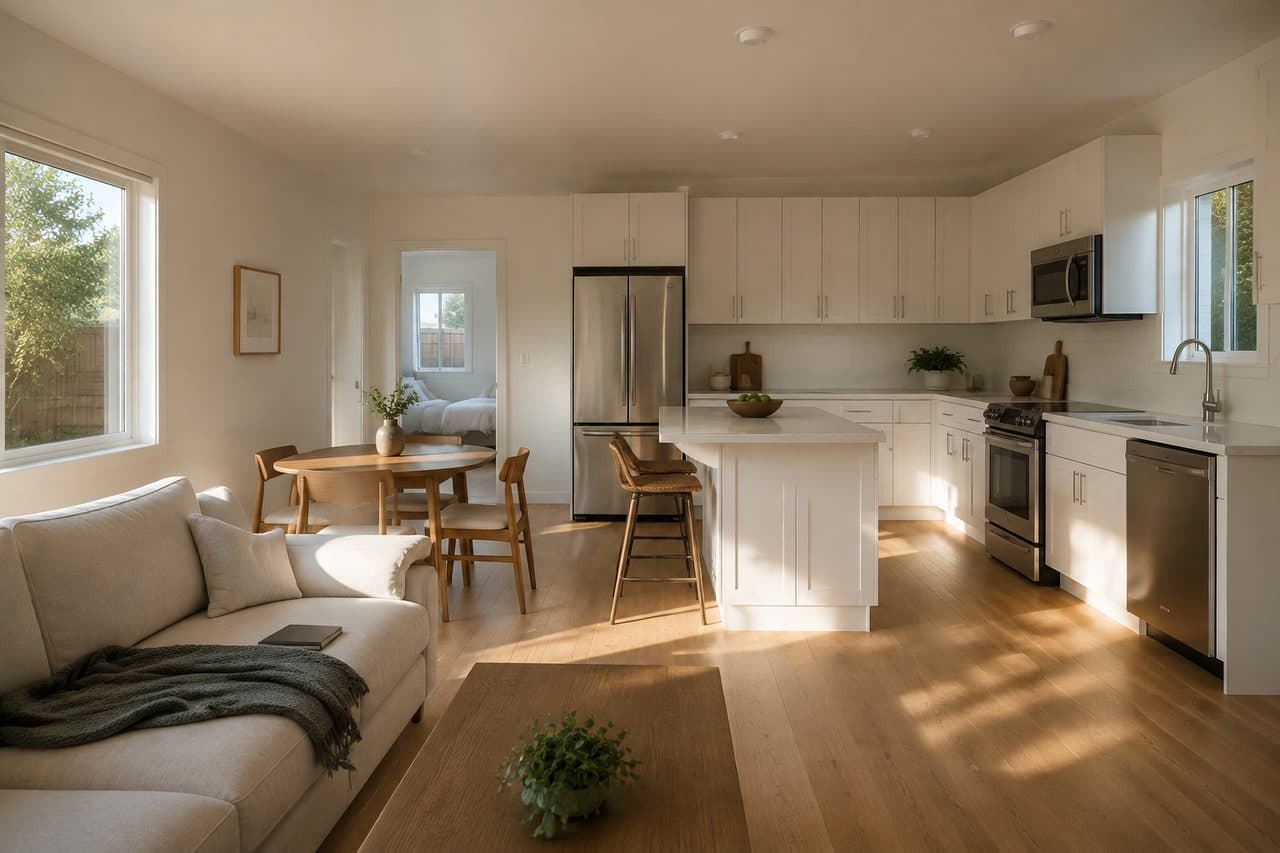
The two options at a glance
| Purpose-built ADU | Assisted living | |
|---|---|---|
| How you pay | A one-time build, often financed — a fixed monthly payment | A monthly fee, often $6,000–$8,000 or more, that typically rises over time |
| Independence | Their own front door, kitchen and routine | A private room or apartment within the community’s schedule |
| Family | A few steps away, every day | A drive away; visits are planned |
| Care | Family, plus visiting or live-in help as needed, arranged separately | Staff on site, with levels of care available |
| Afterwards | A permitted home that adds lasting value to the property | Nothing remains once payments stop |
| How fast | Months: feasibility, design, permitting, then roughly 3–4 months of construction | Weeks, where there’s availability |
Facility costs vary widely by region and level of care. Check current prices where your parent would live.
The cost comparison, worked through
The honest way to compare is over the number of years you expect care to be needed. Here is one example, using round numbers. Every figure should be replaced with your own.
- Assisted living: $6,500 a month for 8 years comes to about $624,000.
- ADU: a $250,000 build financed at a $1,600 monthly payment comes to about $153,600 in payments over the same 8 years.
- What remains: the ADU is still standing, adding value to the property — in this example, an estimated $200,000.
On those numbers the family comes out roughly $470,000 ahead, and owns an asset worth about $200,000. If your parent will need paid in-home help, add that cost to the ADU side — it narrows the gap, and it’s the fair comparison.
Run your own numbers in our free ADU vs. assisted living calculator.
Cost over 5, 10 and 15 years
The longer care is needed, the wider the gap. Using the same example — $6,500 a month for assisted living, $1,600 a month for the ADU loan:
| Years | Assisted living | ADU payments | Difference |
|---|---|---|---|
| 5 | $390,000 | $96,000 | $294,000 |
| 10 | $780,000 | $192,000 | $588,000 |
| 15 | $1,170,000 | $288,000 | $882,000 |
Flat monthly costs, before any paid in-home help on the ADU side. Facility fees usually rise over time while a fixed-rate payment doesn’t, so these figures are conservative in the facility’s favor.
What the numbers don’t show: independence and closeness
Families rarely choose an ADU for the money alone. They choose it because a parent keeps their own kitchen, their own front door and their own routine — while the people who love them are close enough to drop in for coffee.
That closeness matters to health, not just happiness. According to a National Academies report, social isolation in older adults is associated with about a 50% higher risk of dementia, and poor social relationships with a 29% higher risk of heart disease and a 32% higher risk of stroke. A home a few steps away makes everyday, unplanned contact the norm — something no facility can offer at any price.
If a caregiver will be involved
Many families start with independence and add help later. Design for that now: a bedroom with room to reach the bed from both sides, transfer space in the bathroom, blocking for grab bars, a couple of dedicated circuits for equipment, and a way for a caregiver to come and go without passing through anyone’s private space. If care is needed from day one, our guide to ADUs for in-home care covers the details, including the questions to ask the care provider before anything is drawn.
What we’ve seen families do
One grandfather was living in a nursing home at about $8,000 a month, and increasingly cut off from his family. They built a 650 square-foot, care-ready ADU in their backyard: step-free from the car to the door, blocking for grab bars throughout, and a fireplace at the center of the living room. Visits went up enormously, and even after the ADU’s payment the family saves on the order of $6,000 a month. Read the full case study.
Another couple planned ahead. Rather than buy a $500,000-plus house to age in — and still set money aside for assisted living later — they built a 700 square-foot, one-bedroom ADU on their daughter’s property. Her new kitchen and living room ended up larger than the ones in the full-size home she left.
The Age-in-Place ADU Guide
Design a home around the life your parent wants to keep, build it so it holds up as needs change, and pay no more than it should cost.
How families pay for it
- Home equity — a HELOC or home-equity loan against the main house, which keeps an existing low first-mortgage rate in place.
- A construction loan that funds the build in draws, then converts to a mortgage.
- A parent’s own funds — sometimes from selling their house, or money set aside for care, redirected into a lasting asset. One couple used an attorney-drafted trust to direct gifted funds to the build.
- Cash, where it’s available.
Permits and local rules
ADU rules are set by your city or county: where the unit can sit, how large it can be, parking, and sometimes whether the owner must live on the property. Permitting can take anywhere from a few weeks to several months and is usually the least predictable part of the timeline. Start with a feasibility check of the lot — zoning, setbacks, and where the utilities run — before paying for design.
What happens to the ADU later
Unlike facility payments, the home remains. Families go on to use it as a guest house, a home for another relative, or a rental that helps pay for itself — and a permitted ADU adds value when the property is sold. Planning for that from the start costs little: an entrance and outdoor space that can be private, and separate utility meters if it could ever be rented.
When assisted living is the better choice
- Round-the-clock skilled care. If your parent needs 24/7 nursing or constant medical monitoring, a home can’t replace that.
- Advanced dementia with wandering. A secure memory-care setting may be the only safe option.
- No one nearby to coordinate care. An ADU works because family is close. If they aren’t, the advantage shrinks.
- The site can’t support an ADU. Zoning, lot size, septic or access can rule it out. A feasibility check comes first.
- You need a solution in weeks. Design, permitting and construction take months.
What to decide first
Before comparing floor plans, answer these honestly as a family:
- What life does your parent want to keep — their routines, their independence, their privacy?
- What help do they need today, and what is likely in the next five to ten years?
- Who will provide that help, and does the home make it easy for them?
- Can the property support an ADU — and where would it sit relative to the main house?
Our Age-in-Place ADU Guide walks through each of these, room by room, and turns your answers into a brief you can hand any builder.